
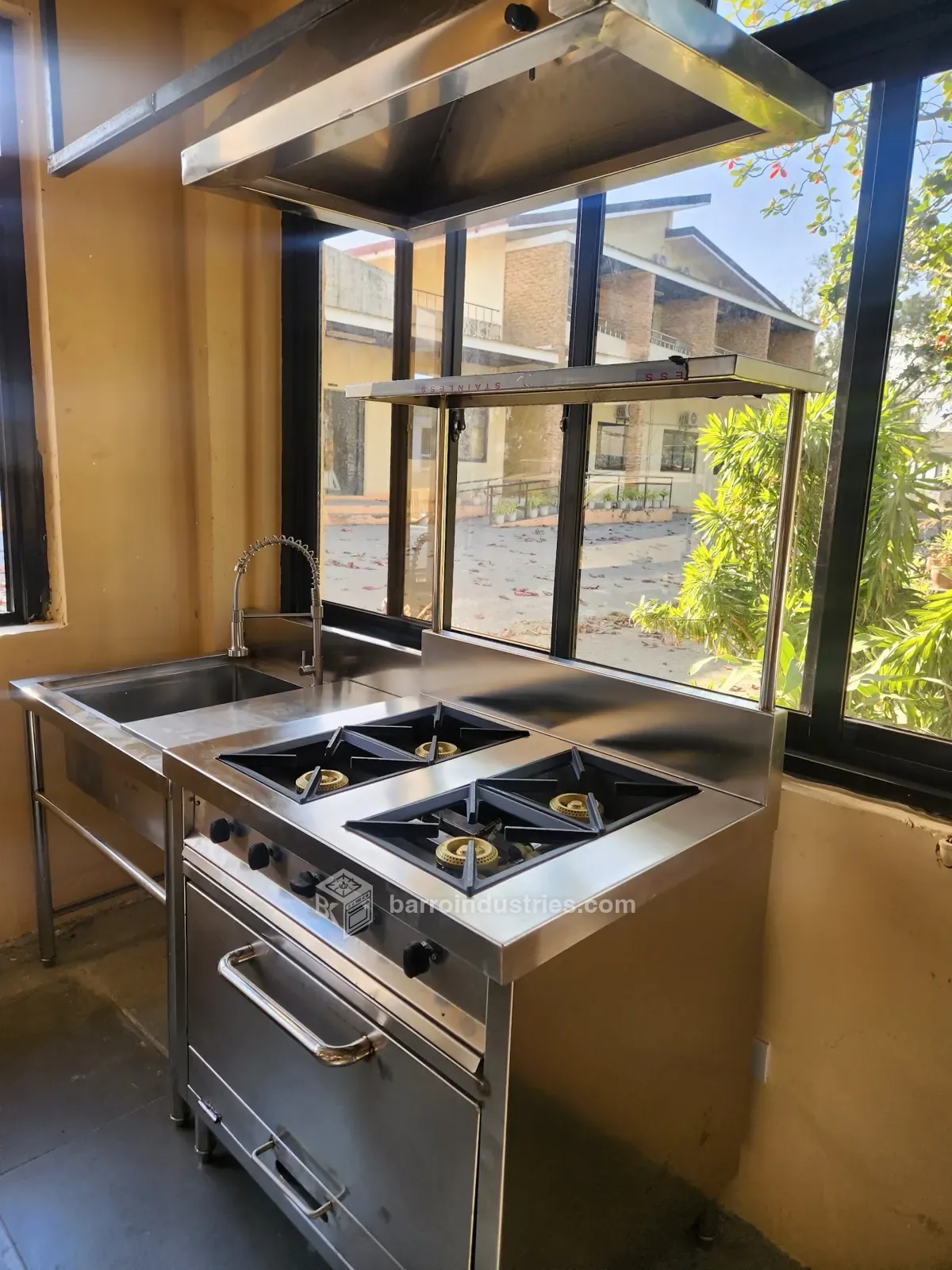
In short
- Keep LPG cylinders outside, in a secured, well-ventilated cage, away from drains and ignition sources.
- Use fully welded black-iron pipe with a shut-off at every appliance. Test it, and add a gas leak detector linked to an emergency auto-shutoff valve.
- Ventilate the cooking line, check for leaks on a routine, and make sure everyone knows what to do if they smell gas.
Plan the gas line before the pipe
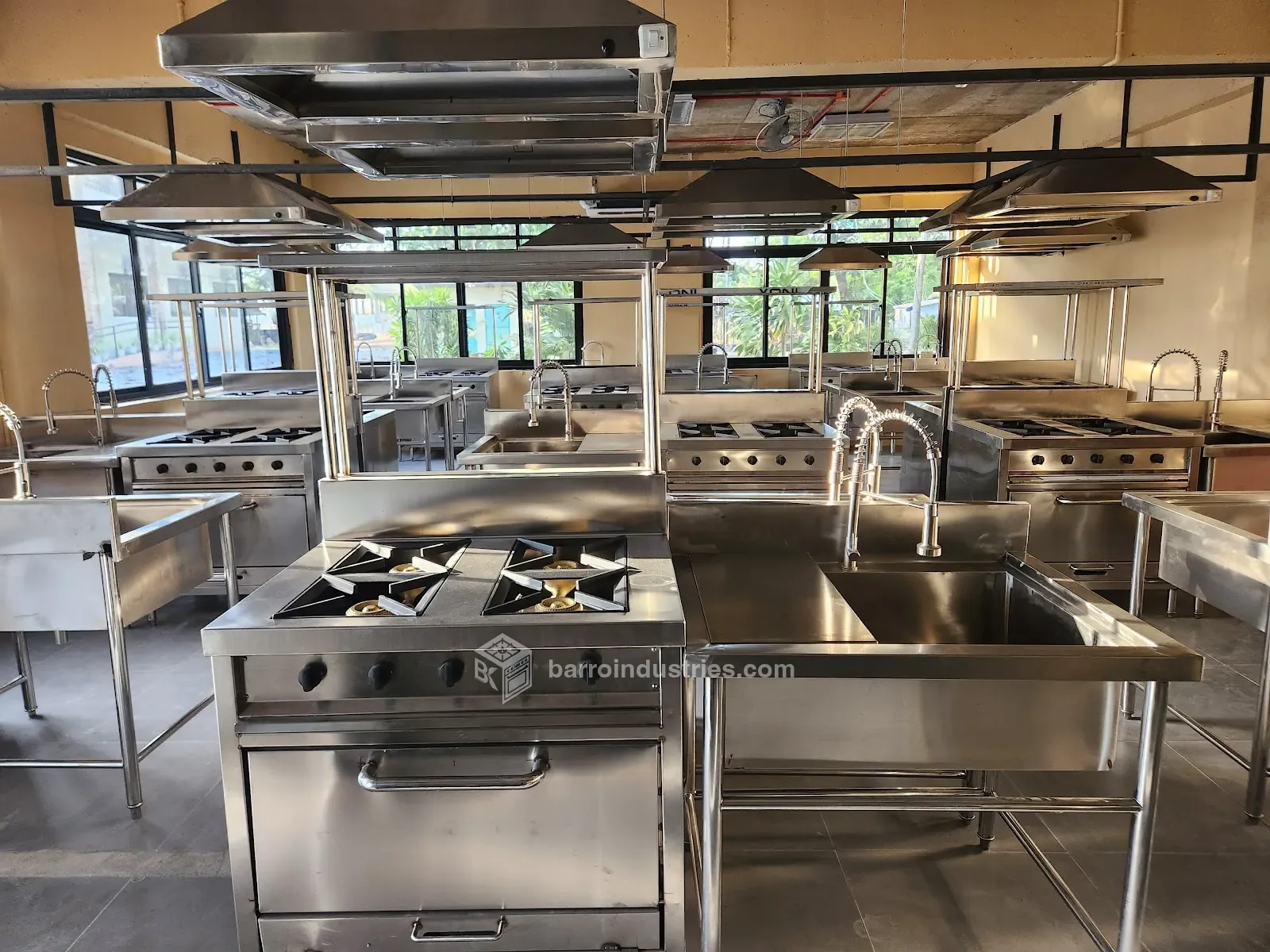
Decide where the gas appliances go first, and group them so the pipe run is short. List every appliance and its burners. A wok range or a gas deck oven draws far more gas than a small gas stove, and the pipe must be sized for everything running at once. LPG is the common fuel here, but check that each appliance is set up for LPG, because natural gas needs different burner jets.
Before the drawings are fixed, ask the Bureau of Fire Protection (BFP), the city or municipal building office and your LPG supplier what they expect for your site. Our LPG gas line installation plans the line with your cooking line, hood and fire suppression, as in the layout guide.
The cylinder area
Cylinders belong outside the kitchen, never inside, where the supplier’s truck can reach. A good cylinder area has:
- A secured cage with open mesh sides and a roof for shade and rain, locked so that only trained people open it. Our standard example holds four 50 kg tanks.
- Firm, level ground, with the cylinders upright and strapped.
- Air moving all round it. LPG is heavier than air, so a leak sinks and collects in low places. Keep the cage away from drains, pits and low corners.
- Distance from ignition sources: no smoking, no sparking equipment, and no rubbish stacked beside it. Add a warning sign and a fire extinguisher close by.
Ask the BFP and your LPG supplier how many cylinders you may keep and how far the cage must stand from the building. We do not guess those distances for you.
Manifold, regulator and pressure
The cylinders connect to a manifold, a common header that feeds the pipe from several of them at once. Many kitchens run two banks, one in use and one in reserve. A regulator brings the pressure down to what the appliances are built for. High-pressure equipment such as wok ranges needs the regulator and pipe sized for it, so tell us what you will run.
The flexible hoses at the cylinder end are the parts most often damaged. Use hoses made for LPG, keep them short, and replace any that are cracked or hardened.
Piping: fully welded black iron
We use fully welded black iron (BI) pipe and fittings. Welded joints are generally less likely to leak than threaded ones. Good practice includes:
- Run the pipe on the surface, supported and clipped, where it can be inspected. Avoid hiding joints inside walls or closed ceilings.
- Protect it with paint or a coating, because black iron rusts, particularly in humid kitchens and near the sea.
- Fit a manual shut-off valve at every appliance, so that one can be isolated for service without stopping the whole kitchen.
- Keep the pipe clear of hot surfaces and electrical cables, and mark the pipe and the main valve so anyone can find them.
Leak testing and commissioning
A gas line is not ready until it is tested. Typical practice has three steps:
- Pressure test. With the appliances disconnected, the empty pipe is pressurised with air or an inert gas, not LPG, and must hold its pressure for a set time.
- Soap test. With the gas on, brush soapy water on every joint, valve and connection. A bubble that grows is a leak.
- Re-test after any change, such as a new appliance, a replaced hose or a cylinder change.
Never look for a leak with a flame or a lighter. During commissioning we connect your equipment to the line and test it for leaks.
Leak detector and emergency shut-off
Two controls matter most. A gas leak detector senses LPG in the air, and because LPG is heavier than air it is normally fitted low on the wall near the cooking line, following the maker’s instructions. It is paired with an emergency auto-shutoff valve that closes the supply when it trips. Add a marked manual shut-off outside the kitchen, near an exit, so the gas can be cut off without walking past the cooking line.
Everyone who works in the kitchen should know where the shut-off is, and what to do if they smell gas:
- Do not switch anything on or off, and keep flames and sparks away.
- If it is quick and safe, close the main shut-off or the cylinder valves, and open doors and windows.
- Get everyone out, then call your LPG supplier’s emergency line and the BFP from a safe distance.
- Do not go back in until the leak has been found and fixed.
Ventilation and upkeep
Burning LPG uses air and gives off heat and combustion gases, so a gas cooking line needs good ventilation: a hood and exhaust to take the heat away, and fresh air to replace what leaves. Our exhaust hood guide explains how. If flames burn yellow or leave soot, call a technician. A fire suppression system integrated with the hood protects the cooking surface.
| When | Check |
|---|---|
| Every day | Look and smell near the appliances, and check that flames are steady. |
| Every week, and at each cylinder change | Soap test the connections at the cylinders and appliances, and check the hoses for cracks. |
| Once a year, or as advised | Have the pipe, regulator, valves, detector and auto-shutoff inspected by a competent technician. |
How Barro Industries can help
Our LPG gas line installation covers the cage, the welded black-iron pipe network, a leak detector with an emergency auto-shutoff valve, the appliance connections and the leak test, on its own or within a full kitchen fit-out.
The quickest way to start is the project brief. List your gas appliances. We give a 6-month service warranty on our equipment and work, and full-kitchen projects include 12 months of preventive maintenance service (PMS) with KitchenShield™.
Frequently asked questions
How is an LPG gas line installed in a restaurant?
The cylinders stand outside in a secured cage. A manifold and regulator feed fully welded black-iron pipe that runs to each appliance, with a shut-off valve at each one, a gas leak detector and an emergency auto-shutoff valve. The line is leak tested before use.
Where should LPG cylinders be stored at a restaurant?
Outside, in a secured and well-ventilated cage on level ground, shaded from sun and rain, and away from drains, ignition sources and building openings. LPG is heavier than air, so a leak collects low. Ask the BFP and your LPG supplier what distances apply.
How do you test an LPG line for leaks?
With a pressure test of the empty pipe using air or an inert gas, then a soapy-water check of every joint once the gas is on. Growing bubbles show a leak. Never use a flame. Repeat the soap check whenever a cylinder, hose or appliance is changed.
What should I do if I smell gas in my kitchen?
Do not touch switches or light a flame. If it is quick and safe, close the main shut-off or the cylinder valves and open doors and windows. Then get everyone outside and call your LPG supplier and the BFP from a safe distance. Do not go back in until the leak is fixed.
Do you install LPG gas lines for restaurants?
Yes. We design, fabricate and install the cage, the piping, the leak detection and the shut-off, connect your appliances and test the line, on its own or as part of a full kitchen fit-out. Send a project brief or message us to start.
© 2026 Barro Industries OPC. All rights reserved. All text, photographs and designs on this page are our own work and may not be copied or reused without written permission.